Why Material Choice Matters
Every 3D printing material brings its own set of strengths and compromises. Pick the wrong one and you might end up with a part that warps in the sun, snaps under pressure, or just doesn't look the way you imagined. Pick the right one and you'll have a finished product that feels genuinely impressive.
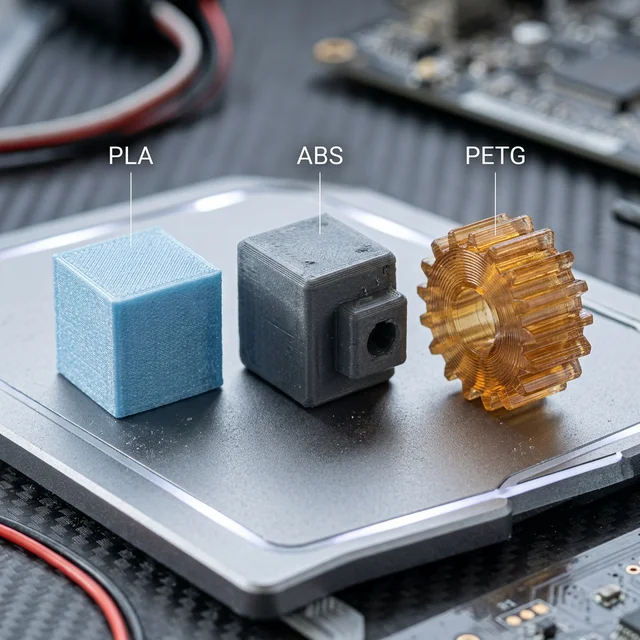
In this guide, we'll compare the three most widely used FDM filaments - PLA, ABS, and PETG - across the factors that matter most: strength, ease of printing, heat resistance, appearance, and cost.
Not sure which to pick? Our team can recommend the ideal material based on your specific project. Just upload your file and tell us what the part is for, and we'll guide you.
PLA - The All-Rounder
PLA (Polylactic Acid) is the most popular 3D printing material in the world, and for good reason. It's made from renewable sources like cornstarch, it prints easily, and it produces parts with excellent surface quality and sharp detail.
Best for
- Prototypes and concept models
- Decorative items and display pieces
- Miniatures and figurines
- Educational projects
- Anything that doesn't need to withstand heat or heavy stress
Limitations
PLA starts to soften around 60°C, so it's not ideal for parts that will live inside a car dashboard or next to a heat source. It's also more brittle than ABS or PETG - it tends to snap rather than flex when force is applied.
ABS - The Tough One
ABS (Acrylonitrile Butadiene Styrene) is the same material used in LEGO bricks, automotive trim panels, and electronic housings. If your part needs to take a knock, ABS is the one you reach for.
Best for
- Functional parts and enclosures
- Automotive components
- Parts exposed to moderate heat (up to ~100°C)
- Items that need to be drilled, sanded, or post-processed
- Snap-fit assemblies
Limitations
ABS is trickier to print than PLA. It requires a heated build chamber to prevent warping and produces fumes during printing, so ventilation is important. The surface finish also tends to show layer lines more prominently, though acetone vapour smoothing can fix that.
PETG - The Best of Both Worlds
PETG (Polyethylene Terephthalate Glycol) sits right between PLA and ABS. It's easier to print than ABS, stronger and more heat-resistant than PLA, and offers a slight translucency that gives prints a premium feel.
Best for
- Functional parts that also need to look good
- Water-resistant applications
- Food-safe containers (with appropriate certification)
- Outdoor use and UV exposure
- Parts needing some flexibility under stress
Limitations
PETG can be slightly stringy during printing, which may affect fine details. It's also softer than ABS on the surface, meaning it scratches a bit more easily. For ultra-fine detail work, PLA might still edge ahead.
Head-to-Head Comparison
| Property | PLA | ABS | PETG |
|---|---|---|---|
| Strength | Moderate | High | High |
| Flexibility | Low (brittle) | Moderate | Moderate–High |
| Heat Resistance | ~60°C | ~100°C | ~80°C |
| Surface Finish | Excellent | Good (sanding needed) | Good (slight gloss) |
| Ease of Print | Very Easy | Moderate | Easy |
| UV Resistance | Low | Moderate | High |
| Cost | £ | ££ | ££ |
| Best Use | Display & prototyping | Functional parts | All-purpose |
So, Which Should You Choose?
Here's the short version:
- Choose PLA if you want beautiful prints with sharp detail, and the part won't be under mechanical stress or near heat sources.
- Choose ABS if you need toughness, heat resistance, and don't mind a bit of post-processing for a smooth finish.
- Choose PETG if you want a versatile, durable material that handles both functional and aesthetic projects well.
Still unsure? Upload your 3D file and tell us what the part is for. We'll recommend the best material for your project - no extra charge.